
How I work
I’m most useful when the answer isn’t obvious yet.
I’m a designer and operator who works across product, systems, brand, technology and business.
My best work usually begins with a messy problem:
- 01
a customer journey that isn’t working,
- 02
a manual process that shouldn’t be manual,
- 03
a product that doesn’t exist yet,
- 04
or an opportunity everyone can see but nobody has had the bandwidth to own.
Give me ownership of the problem, not a predetermined solution. I need access to how the work really happens, the people closest to it, and enough authority to build and test something. With that, I’m very good at turning ambiguity into something real.
My superpowers
-
01
Seeing the system.
I tend to see the connections between customer behavior, product, operations, technology, brand and revenue. Often the problem showing up in one department is actually being caused in another, and that’s usually why nobody has fixed it.
-
02
Going from zero to working.
I love the early, difficult part: listening, framing the problem, sketching the system, building the first version and putting it in front of people. I’m comfortable starting with nothing but ambiguity and ending up with something people actually use.
-
03
Design beyond the surface.
I’m a designer, but I use design on systems, workflows, offers, interfaces, customer journeys and physical spaces, not just on how things look. Who is this for? What do they need? Where is the friction? What would make the experience feel inevitable?
-
04
End-to-end ownership.
I can take a problem from figuring it out, to designing the fix, to building it and putting it to work, without handing it off every time the discipline changes. Fewer handoffs means less gets lost, and someone stays accountable for whether it worked.
-
05
Making the product and the story agree.
I care deeply about the relationship between what a company promises and what a customer actually experiences. Product, customer journey, brand and voice should feel like parts of the same world.
-
06
Working with people who know more than I do.
I’ve spent much of my career with directors, engineers, fabricators, operators and customers who know their discipline better than I do. I learn their language quickly, take hard criticism without getting precious, and turn strong points of view into one thing we can build together.
Good fits
Bring me something like this:
- 01
A new product that needs to get from idea to MVP.
- 02
A sales or customer journey with obvious leakage but no clear system for fixing it.
- 03
A job that left with the person who did it, like sales or intake, and was never really rebuilt.
- 04
A business process that has grown organically and now needs to be rethought.
- 05
A project requiring product, design, technology and operations to work together.
- 06
A company that knows there is an opportunity but doesn’t have an internal person with the bandwidth to own it.
- 07
A difficult problem where the brief is closer to “figure this out” than “execute these twelve predetermined steps.”
Not my best use
I’ve learned that there’s another category of work where other people are considerably better than I am. If you’re deciding where to put me, this matters as much as the list above.
Not my best use
Keeping a mature process running, indefinitely.
I’m not naturally a PMO, administrator or keeper of recurring process. Recurring compliance deadlines, month-end bookkeeping, routine status tracking, chasing every outstanding item: that’s not where I create disproportionate value.
Good at instead
That doesn’t mean I can’t create process. I’m good at understanding a messy operation, designing how it should run, establishing the workflow, building the tools and getting the machine going. Once the main job becomes keeping it going, someone else should own it.
Pairs well with
A detail-oriented counterpart who loves consistency, documentation, administration and scheduling, and makes sure every train arrives exactly on time.
Not my best use
Political environments.
I’m less effective where ownership is deliberately vague, decisions happen through maneuvering, protecting territory matters more than solving the problem, or nobody is empowered to decide.
Good at instead
Disagreement, strong personalities, direct criticism and talented people challenging one another. I change my mind when the evidence changes.
Pairs well with
One clear owner who can make decisions, back the work, and tell me when I’m wrong.
That doesn’t mean I need agreement.
Quite the opposite.
What matters to me is that the disagreement is direct, respectful and in service of making the work better.
The environment where I do my best work
- Clear outcome.
- Hard problem.
- High trust.
- Talented people.
- Direct communication.
- Room to operate.
In that environment, I’ll learn the terrain, talk to the people involved, figure out what should exist, build enough of it to find out whether we’re right, and keep improving it from there.
Evidence · PARDNER
What that looks like.
PARDNER is the clearest recent example. The point isn’t the startup. It’s what happens when I run into an ambiguous business problem.
 Founder, designer & builder · Live in early access
Observed.
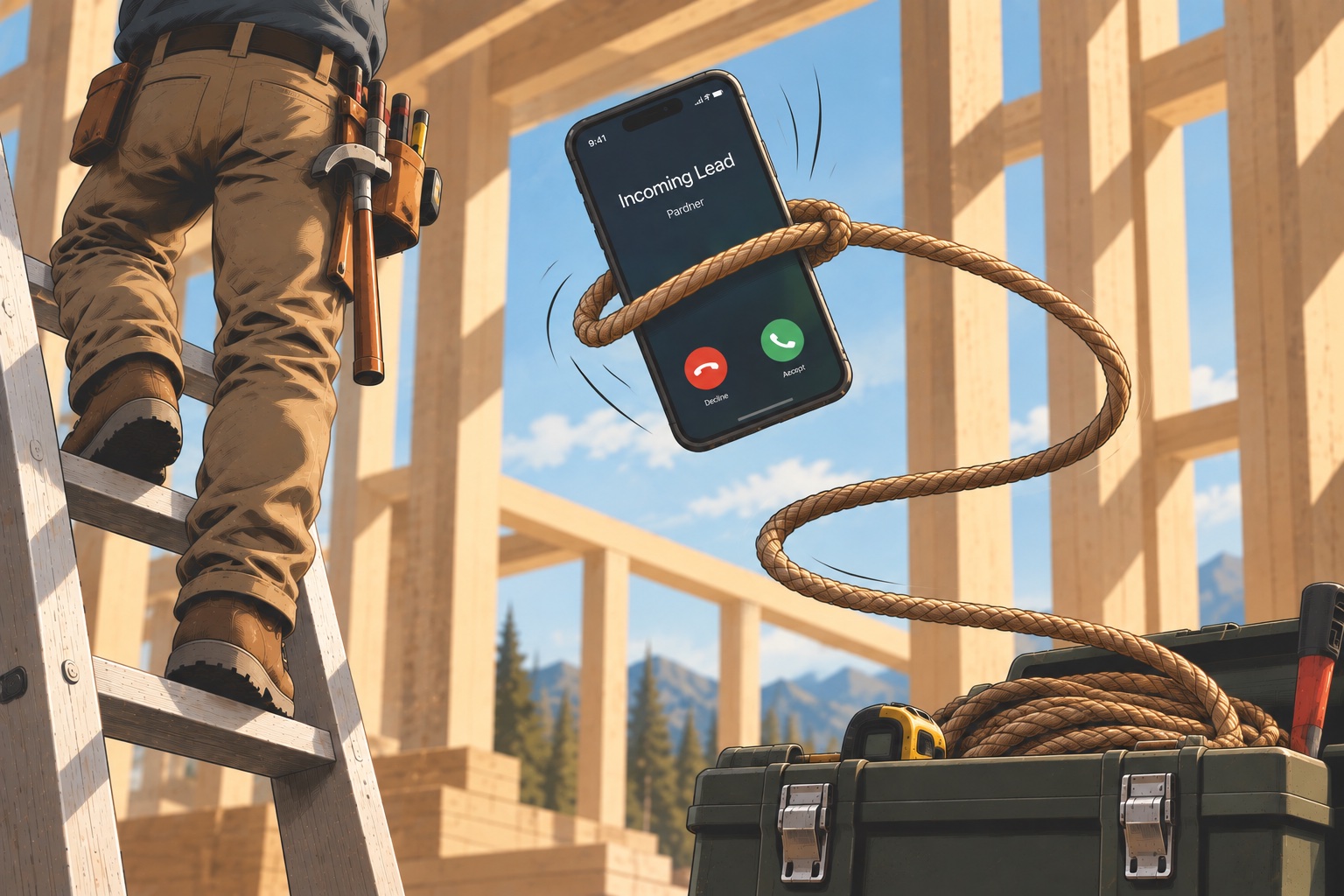
Talking with contractors, I kept hearing something counterintuitive. Their phones were already ringing. They missed calls because they were doing the work: under a house, on a ladder, running equipment. The customer simply called the next contractor.
Reframed.
The problem wasn’t generating more leads. It was rescuing value that was already coming into the business, and, when a job wasn’t a fit, passing it to someone they trust instead of letting it die.
Designed.
A trust-first model. Miss a call and PARDNER texts the customer back; the contractor decides, by text, whether to take the job or refer it. They keep their number. Nothing is automated until they’ve watched it work. No customer’s number moves without their OK. The contractor never gives up the relationship.
Built.
The service model, customer journey, onboarding, brand and voice, the application, database and authentication, and the telephony and messaging architecture. Real calls, real texts.
Tested.
I put it in front of real contractors and tested it on actual unanswered calls, learned from what people did rather than what they said, changed my assumptions, and kept building.
Whether PARDNER ultimately becomes a large standalone company is almost secondary to what the project represents:
- Listen
- Understand
- Design
- Build
- Test
- Learn
- Ship
That loop is where I’m happiest.
The short version
If you have an important problem that crosses departments, doesn’t have an obvious answer, and needs somebody to take ownership of figuring it out—I’m probably useful.
Bring me a problemGet in touch
BRING ME
A PROBLEM.
What’s stuck? Who’s doing it now? What would change if it worked? You don’t need a polished brief.
This comes straight to me. Or email adam@adambyrne.com.
Rather talk it through?
Book a 30-minute callChoose a time
Calendar not loading? Open Calendly ↗